This page covers Step 4 (creating the application) and SCIM setup for PingOne. Everything else — enabling SSO, entering credentials, access policy — is the same for all providers and is covered in SSO Setup.
Copy the callback URL from G360 first. Go to Settings → SSO Settings, turn on Enable single sign-on, and copy the read-only Callback URL from the Identity Provider section. You paste it into PingOne below.
PingOne is the only provider where one application handles both SSO and SCIM. Everything below stays within a single app.

Create the OIDC application

Console: your PingOne environment — use your production (or sandbox) environment, not the Administrators environment, which is for managing the tenant rather than running applications. Applications → Applications → + → OIDC Web App.
PingOne defaults new applications to Client Secret Basic and enforces that choice strictly. Leaving the default causes a perfectly successful login to fail at the very last step with invalid_client“Unsupported authentication method.” Set this to Client Secret Post before saving.

Grant the scopes explicitly

On the application’s grant/scopes screen, attach openid, profile and email from the openid resource.
PingOne does not grant a scope just because it is requested — the application must be entitled to it. This is the step most often missed, and both failures read like a G360 bug.

Enable the application and grant access

New PingOne applications are created disabled. Enable the application, then assign the population or group that may use G360. An assigned-but-disabled application fails in a way that reads like a configuration error rather than “it is switched off.”

Collect the credentials

From the application, copy the Client ID and Client Secret.
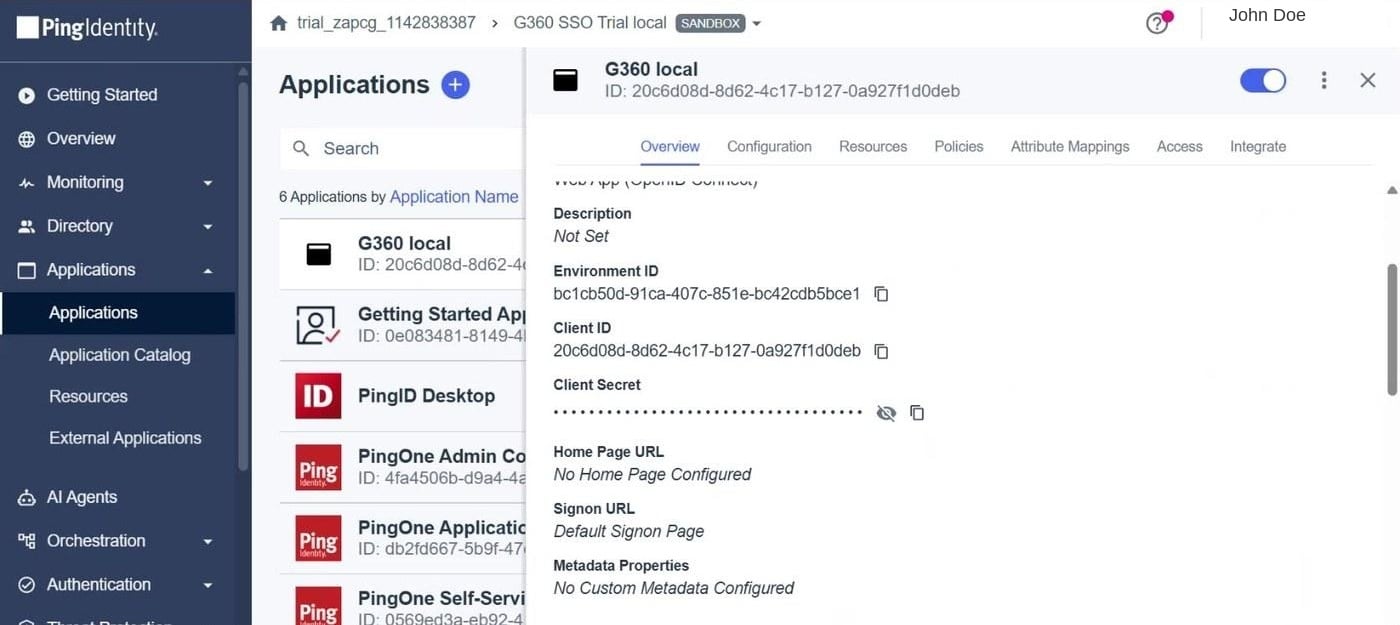
PingOne application Overview tab listing Environment ID, Client ID, and a masked Client Secret

PingOne application overview showing the Environment ID, Client ID, and Client Secret.

Issuer URL

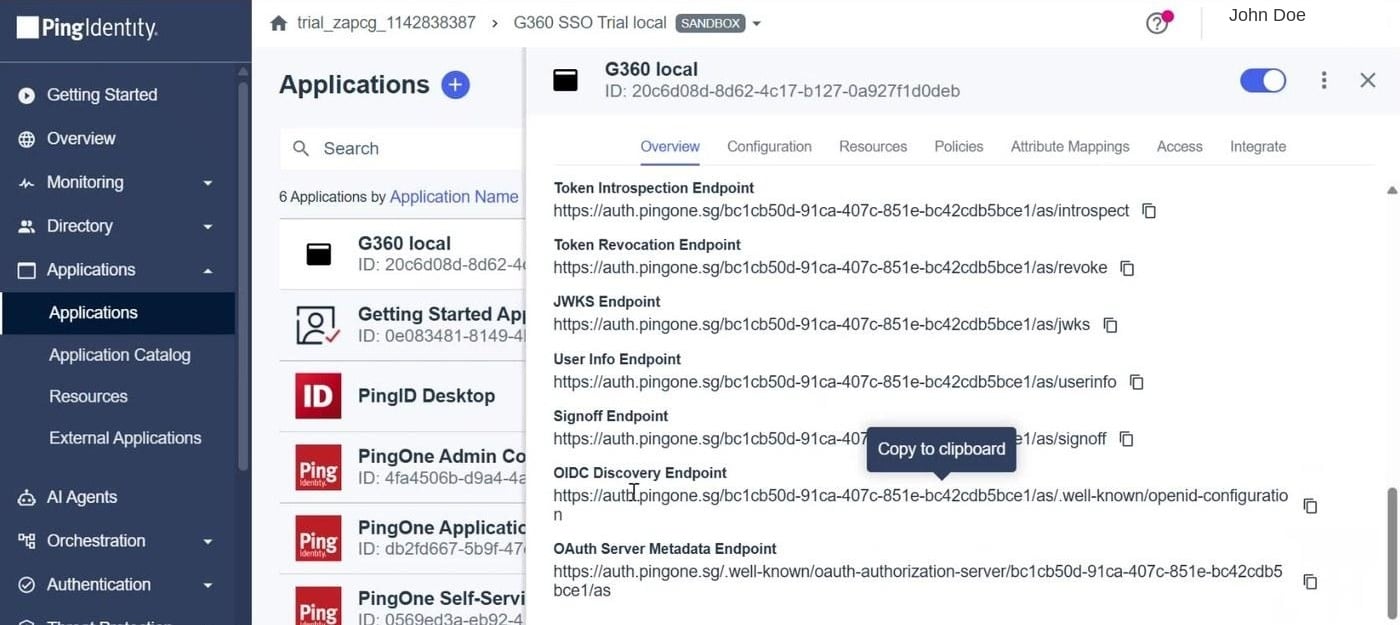
Shown as the OIDC Discovery Endpoint on the application’s Overview tab:
Issuer URL
PingOne application Overview tab showing token, JWKS, userinfo, and OIDC Discovery endpoints with copy buttons

The OIDC Discovery Endpoint listed on the PingOne application's Overview tab.

Two things people get wrong, both of which produce a 404 that looks like a wrong environment ID:
  • The region is part of the domain, not a path segment — auth.pingone.eu for Europe, auth.pingone.sg for Singapore (its own region, not covered by Asia-Pacific’s .asia domain).
  • There is an /as/ segment before .well-known.
Copy the value directly from the console with PingOne’s copy control rather than typing it.

Next: enter the details in G360

You now have the Client ID, Client Secret and Issuer URL. Return to Step 5 of the setup guide to enter them, test the connection, and save.

SCIM provisioning

First, generate a SCIM token in G360. Open the provisioning section of the same application you created above and paste the token there, along with your G360 SCIM endpoint (shown alongside the token in G360’s SCIM Provisioning section).
Map the field that becomes SCIM’s userName attribute to the user’s email address. PingOne defaults this to the directory username instead — a short login name such as suraj_p — which prevents it from ever matching a provisioned user to an existing G360 account.The failure is quiet and never recovers on its own: PingOne searches for a user G360 doesn’t hold, tries to create them, is told the email already exists, and repeats that on every sync — so no update or deprovision ever arrives either.
Paste the token raw, with no Bearer prefix — PingOne supplies that itself.

Verify deprovisioning

Disabling or unassigning a user in PingOne moves their G360 account to Suspended, and they can no longer sign in.
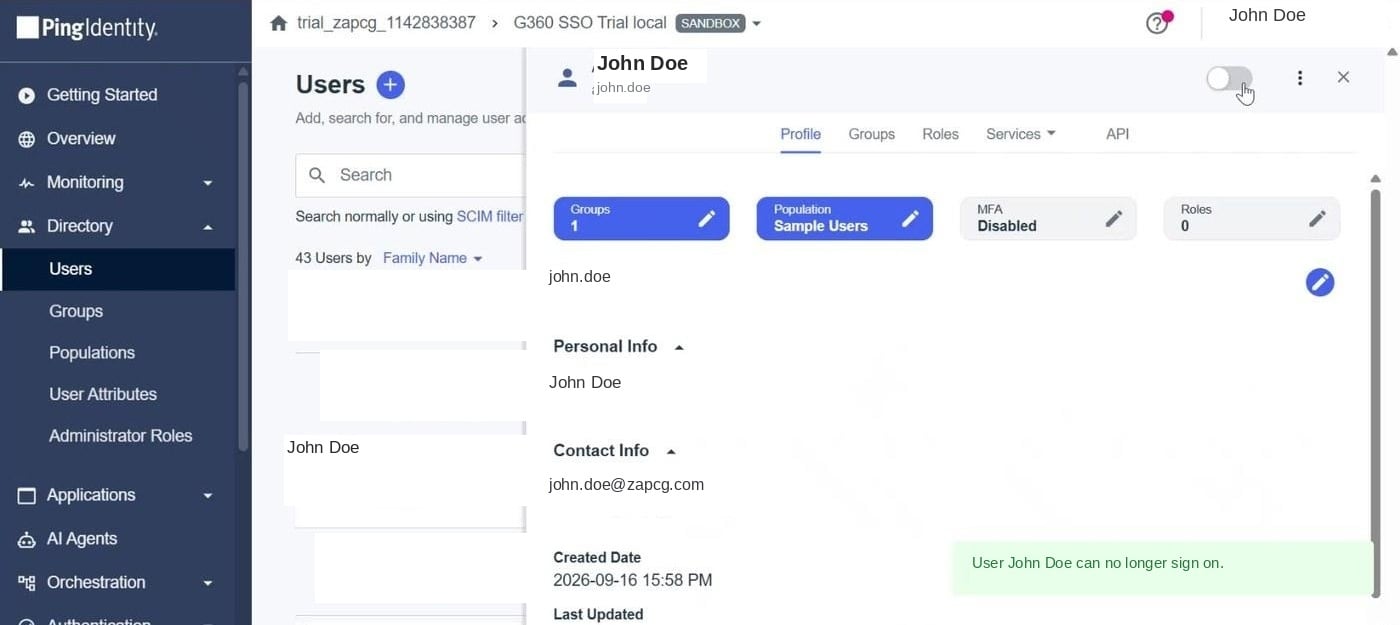
PingOne user profile with the enabled toggle switched off and a confirmation that the user can no longer sign on

Disabling a user's sign-on access in PingOne.

An existing G360 session survives until it expires — deactivation gates the next sign-in, not the current one. Test with a fresh private window.

Provider-specific errors

If PingOne’s own screen shows an error before you’re redirected back to G360, the problem is on its side. For errors that appear after you’re back in G360, see Troubleshooting.