Create a dedicated Bitbucket service account for Garth rather than binding
the integration to a personal account. Code reviews will be attributed to this
account.
1
Register the account
Log out of your personal Bitbucket account and create a new user specifically for this integration.
2
Finalize the profile
Set the username to something identifiable, such as GPRABot. - Use a team
alias email rather than a personal address. - Enable Two-Step Verification
(2FA) if required by your company policy.
3
Associate with your workspace
Add the new service account to your primary Bitbucket workspace and grant it at minimum Developer access on the projects you want Garth to analyze.
When you rotate the service account later, update the token in Garth and
re-enable repository tracking — no other reconfiguration is needed.
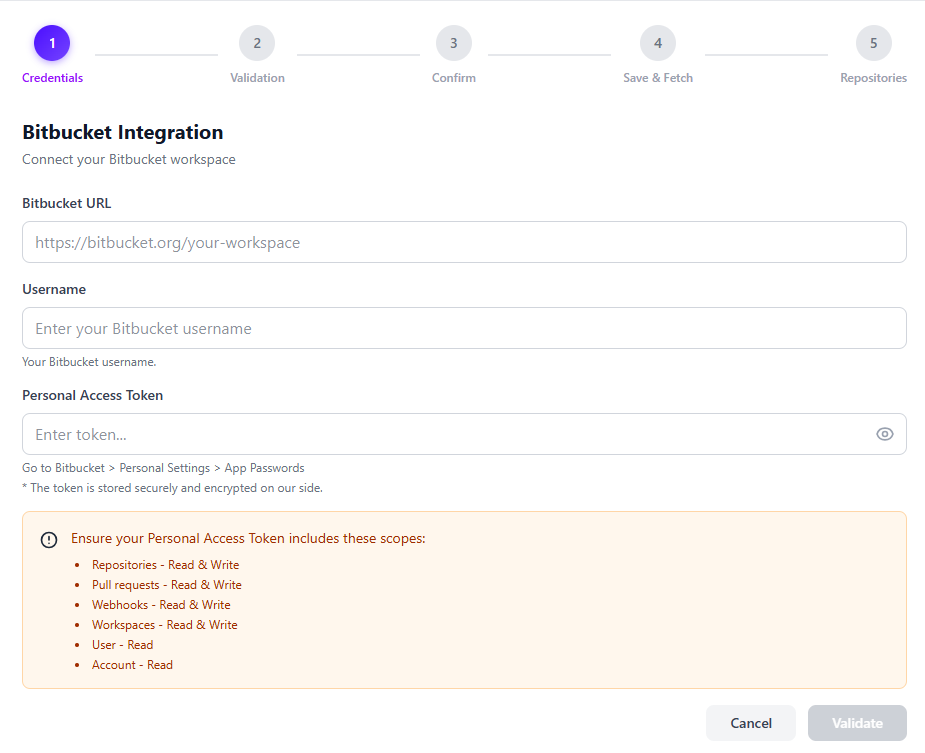
Select the Bitbucket tab. Enter your Bitbucket URL
(https://bitbucket.org/your-workspace), Username (the service account’s
email), and Personal Access Token, then click Validate.
Enter your Bitbucket URL, username, and Personal Access Token, then click Validate
3
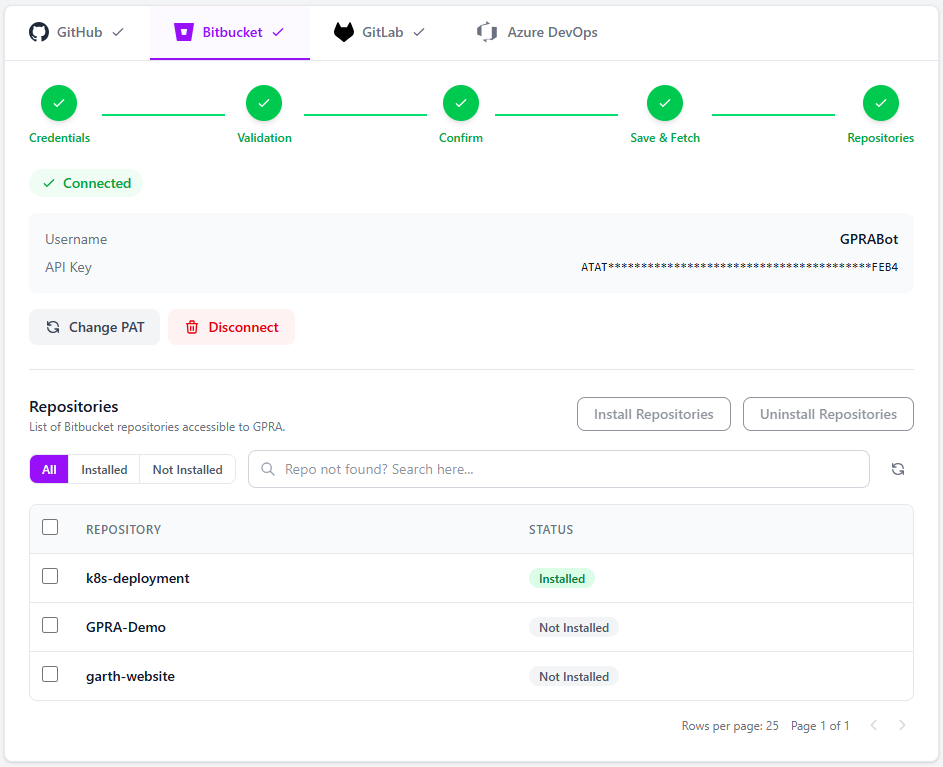
Install repositories
After validation, select the repositories you want Garth to review and click Install Repositories.
Automatic webhooks: Garth installs webhooks on selected repositories automatically. No manual webhook configuration is required. Webhooks are also removed automatically when you uninstall a repository.
Select the repositories you want Garth to review and click Install Repositories
Verify Auto Review is enabled — ensure the Auto Review toggle is turned on for the repository.
Check branch exclusions — confirm the source or destination branch of your PR is not listed under Source Branches to Exclude or Destination Branches to Exclude.
Check file exclusions — verify that the files changed in your PR are not covered by patterns in Files to Exclude.
Authentication errors
If you receive authentication or permission errors:
Check token expiry — Bitbucket API tokens can expire; regenerate and update the token in Garth if needed.
Confirm the username field — the Username entered during setup must be the service account’s email address, not a display name.
Verify 2FA compatibility — if Two-Step Verification is enabled, confirm the API token was generated under Personal Settings → API Tokens, not via a password-based approach.
Re-authenticate — update the token in the Bitbucket integration settings in Garth and re-link with a freshly generated token.